Service-to-service and workload identity
A service on Kubernetes, a GitHub Actions job or a Lambda function already has an identity from its platform. LumoAuth accepts that identity and exchanges it for a short-lived token limited to one API. Where a secret is unavoidable, client credentials, mutual TLS and sender-constrained tokens keep it safe.
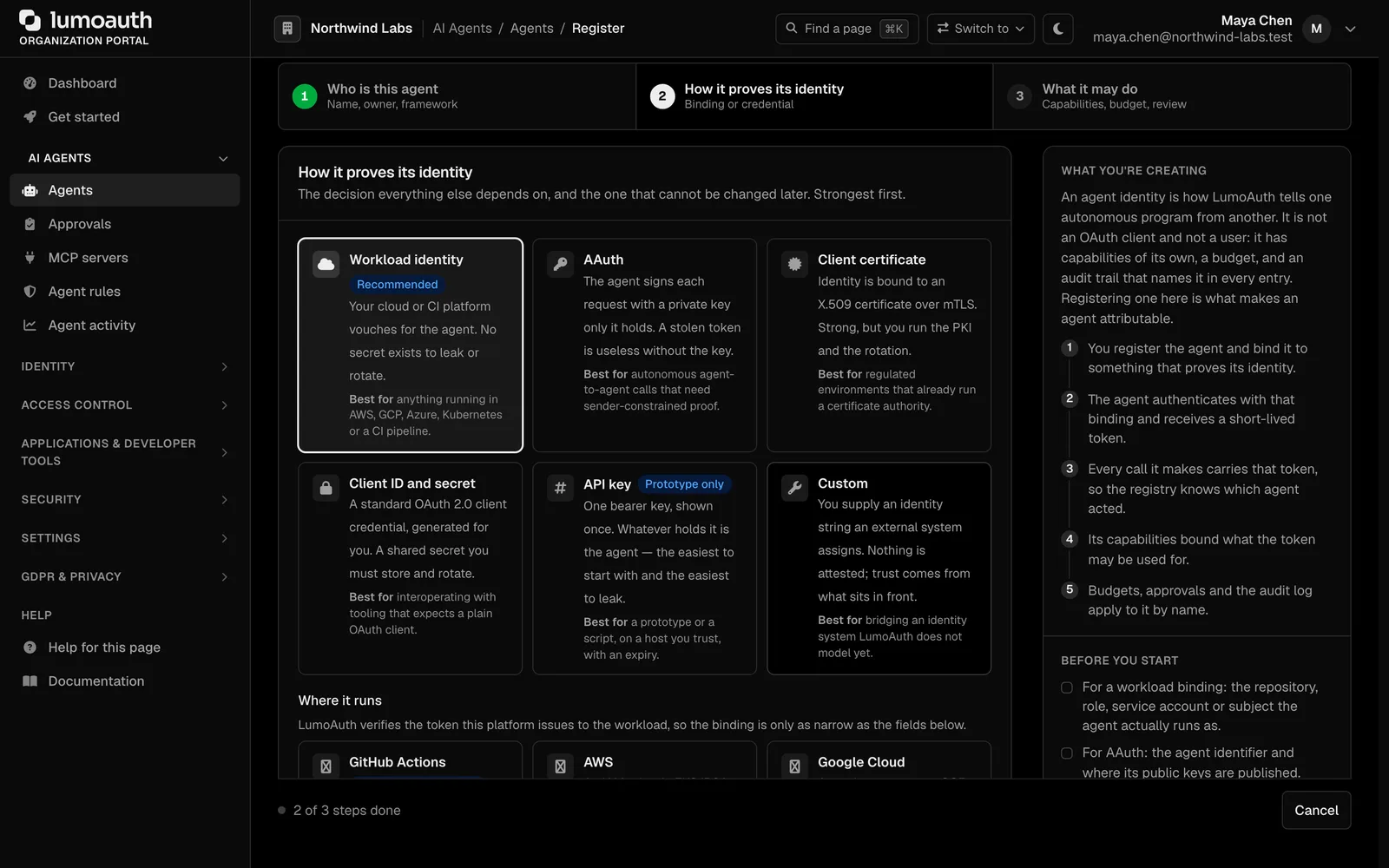
Secrets in CI and config files are the leak that keeps happening
Long-lived client secrets get copied into pipelines, logs and laptops. Rotating them breaks things, so nobody does.
How LumoAuth solves it
Workload identity federation
AWS (IRSA), Azure, Google Cloud, Kubernetes projected tokens, SPIFFE, GitHub Actions, GitLab CI, CircleCI, Buildkite, Azure DevOps, Terraform Cloud, Cloudflare Workers, Vercel and any OpenID Connect issuer. Docs
Client credentials and JWT bearer
Standard OAuth for services that have a secret. Secrets are hashed at rest and rotated from the portal. Docs
Sender-constrained tokens
DPoP binds a token to the caller's key; mutual TLS binds it to a certificate. A copied token is useless elsewhere. Docs
One API per token
Resource indicators pin a token to a single audience, so the billing service cannot call the user service with it. Docs
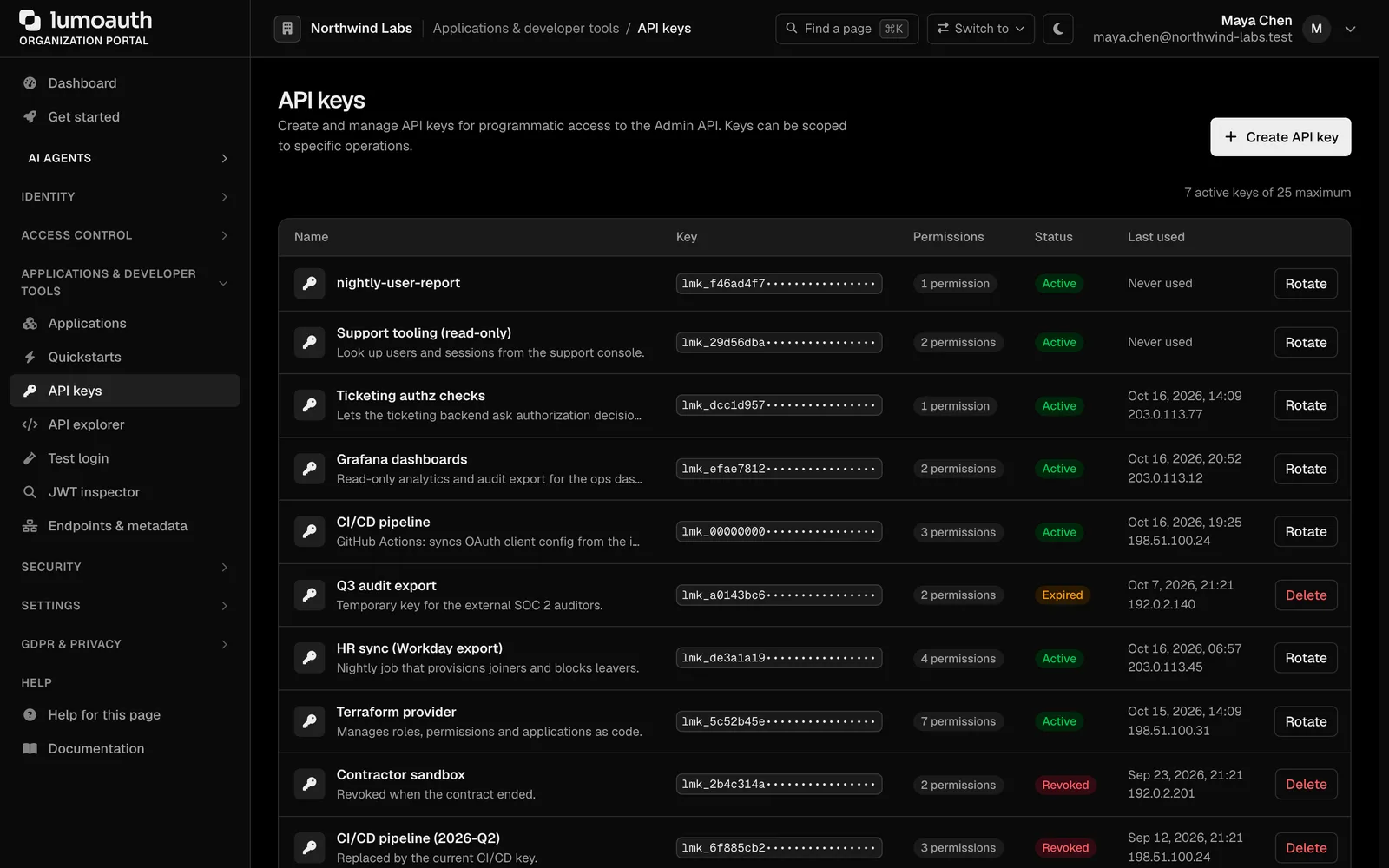
Kubernetes and Terraform
Create clients and agents from a Kubernetes Job, and keep configuration in version control with the Terraform provider. Docs
Setting it up
Register the workload
Pick the platform, paste the issuer and subject pattern (for example a GitHub repository and branch).
Exchange the platform token
The SDK or one HTTP call turns the platform's identity token into a LumoAuth token.
Call your API
The API validates the token against the published keys and checks the audience.
Standards involved
Plain names on the left, the specification on the right. The full map is in the standards reference.
- JWT bearer and client authentication
- RFC 7523
- Token exchange
- RFC 8693
- Mutual TLS
- RFC 8705
- DPoP
- RFC 9449
- Resource indicators
- RFC 8707
- Workload identity
- SPIFFE JWT-SVID
Which plan you need
Client credentials, token exchange and scoped API keys are on every plan with a monthly allowance of machine-to-machine tokens (1,000 on Developer, 10,000 on Pro, 100,000 on Business, then a published per-token price). Cloud workload identity is a $99/month add-on on Pro and included in Business; GitHub Actions attestation is free on every plan. DPoP starts on Pro; mutual TLS is on Business.
Documentation
Questions
Is an agent the same thing as a workload?
Ship passwordless sign-in this week. Put guardrails on your agents today.
The Developer plan is free for 10,000 monthly users and ten agents, with no card. Everything speaks open standards, so moving in or out is a config change.